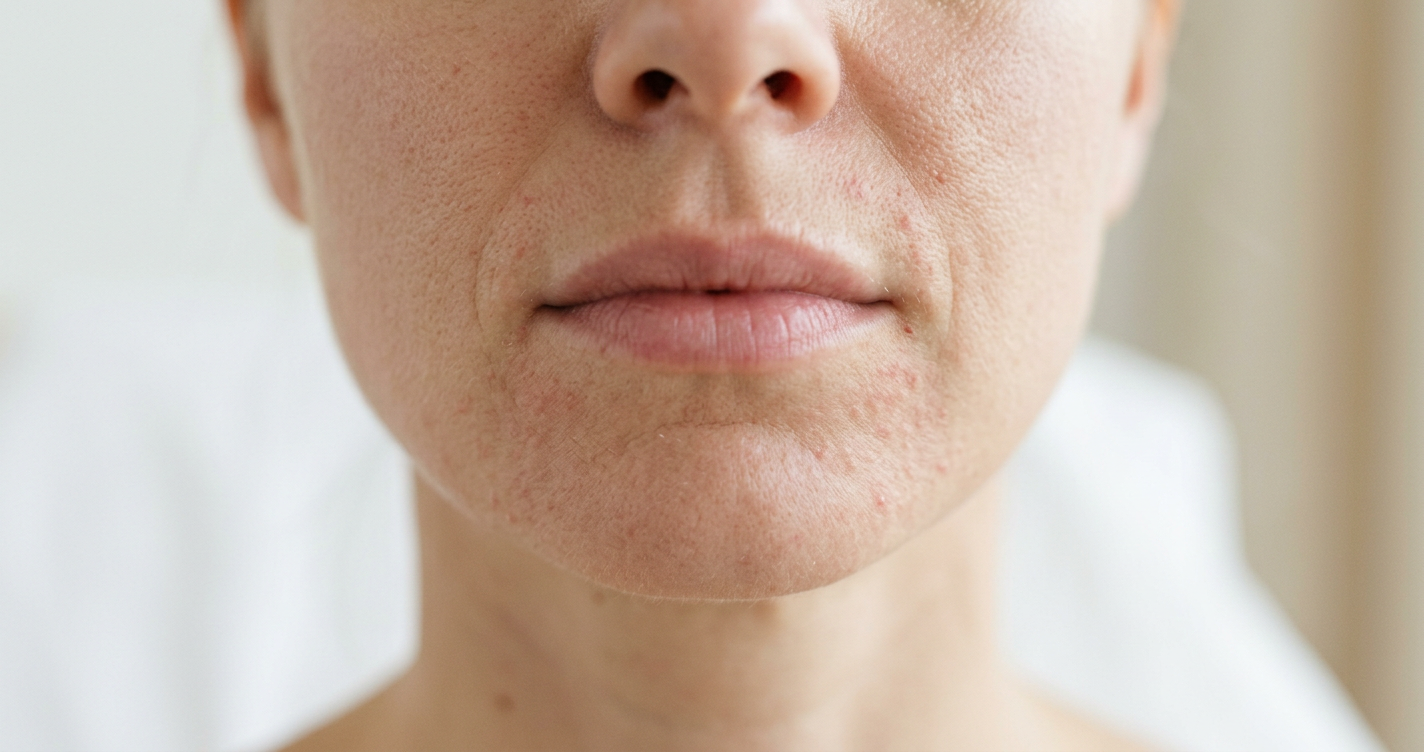
Redness, small pustules, and an uncomfortable tightness around the mouth—does this sound familiar? If so, you’re not alone.
Perioral dermatitis affects a surprisingly large number of people, especially women between the ages of 20 and 45, and is often mistaken for acne or rosacea.
Here’s the tricky part: the more skincare products you apply, the more stubborn the perioral dermatitis becomes. Less is often more in this case—and having the right knowledge is the first step toward improvement.
In this article, you’ll learn how to recognize perioral dermatitis, what triggers it, and how to restore your skin’s balance step by step.
Perioral Dermatitis: When the Skin Around Your Mouth Acts Up
Redness around the mouth, small pustules, and a tight, pulling sensation that just won’t go away— even though you’re taking care of your skin daily and being gentle with it. If this sounds familiar, you’re not alone.
What many initially mistake for acne or dry skin is often perioral dermatitis —also known as “mouth rose” or “stewardess disease.” The latter term stems from the fact that this skin condition used to be particularly common among women who applied makeup and rich creams daily.
The good news: You don’t just have to put up with this stubborn redness. With the right knowledge and a gentle, targeted skincare routine, you can provide real relief for your skin.
What is perioral dermatitis—and why is it also called “mouth rose”?

Perioral dermatitis is an inflammatory skin condition on the face that typically manifests as patchy redness, small pustules, and a slight feeling of tightness around the mouth.
The term is almost self-explanatory: “perioral” comes from Latin and simply means “around the mouth”— exactly where the inflammation most commonly appears. Sometimes it also spreads to the chin, nasolabial folds, or cheeks.
Perioral dermatitis is not uncommon. It primarily affects women between the ages of 20 and 45, although men and children can also develop the condition.
The condition earned its historical nickname, “stewardess disease,” from an observation made in the 1960s and 1970s. At that time, it was noticed that women with intensive skincare routines—heavy makeup, rich creams, and frequent cleansing—were strikingly often affected. Flight attendants were seen as the epitome of these skincare habits back then.
Today we know that certain ingredients and overly intensive skincare can disrupt the delicate skin barrier and contribute to inflammation of the facial skin. This isn’t a matter of blame—but rather a reminder that less is sometimes actually more.
Perioral dermatitis, “stewardess disease”—many names, one condition
Whether it’s “perior al dermatitis,” “stewardess disease, ” or “perioral dermatitis” —all three terms describe the same condition. The variety of names often causes confusion when you’re searching for answers online.
Important to know: Each of these terms refers to the same condition —red, inflamed skin around the mouth, sometimes accompanied by small pustules or flaking. If you know one term, you know them all.
Recognizing Symptoms: This Is What Perioral Dermatitis Looks Like
 The symptoms of perioral dermatitis are characteristic—if you know what to look for, you’ll often recognize the condition at first glance.
- Redness around the mouth, sometimes also around the nose and eyes
- Small blisters and papules —tiny, raised bumps that feel inflamed
- Burning and itching, especially after applying skincare products
- A characteristic clear strip right along the lip line—the skin immediately at the edge of the lips is usually spared
- Mild flaking or dry patches in the middle of the reddened areas
- The skin’s condition often worsens after applying creams or during times of stress
Because the skin on the face can look similar in perioral dermatitis as it does in other conditions, this overview will help you identify it:
| Characteristic | Perioral dermatitis | Acne | Rosacea |
|---|---|---|---|
| Location | Around the mouth, nose, and eyes | Forehead, cheeks, chin | Cheeks, nose |
| Blisters/papules | Yes, small areas | Yes, some are large | Rare |
| Clear strip on the lip | Typical | No | No |
| Trigger | Creams, cortisone | Sebum, bacteria | Heat, alcohol |
Self-diagnosis is never a substitute for seeing a dermatologist. If you recognize these symptoms in yourself, have your skin condition professionally evaluated—for a reliable diagnosis and the right treatment plan.
Perioral dermatitis, acne, or rosacea—what’s the difference?
Perioral dermatitis, acne, and rosacea all cause facial redness —but the differences are crucial for an accurate diagnosis.
| Characteristic | Perioral dermatitis | Acne | Rosacea |
|---|---|---|---|
| Location | Around the mouth, nose, and eyes | Forehead, cheeks, chin | Cheeks, nose |
| Papules & vesicles | Yes, small areas | Yes, some are large | Rare |
| Unaffected strip on the lip | Typical | No | No |
| Trigger | Creams, cortisone | Sebum, bacteria | Heat, alcohol |
Self-diagnosis is never a substitute for seeing a dermatologist. If you recognize these symptoms in yourself, have your skin condition professionally evaluated—to ensure an accurate differential diagnosis and the right course of treatment.
Causes and Triggers: What’s Behind Perioral Dermatitis?
 The exact cause of perioral dermatitis has not yet been fully elucidated scientifically—which sometimes turns the search for your personal trigger into a real detective’s work.
One thing is clear: There are a number of triggers that can disrupt the delicate skin barrier around the mouth, nose, and eyes and contribute to inflammation.
- Corticosteroid-containing creams —this is the most important warning: Corticosteroids provide short-term relief from redness but significantly worsen perioral dermatitis in the long term. Anyone who applies corticosteroid-containing products to their face risks a so-called rebound effect when they stop using them.
- Rich skincare products —heavy creams containing emulsifiers, silicones, or mineral oils can overwhelm the skin barrier and promote inflammation.
- Toothpaste containing fluoride —contact with fluoride is considered a possible trigger, especially for sensitive skin around the mouth.
- Hormonal fluctuations —the menstrual cycle, birth control pills, or hormonal changes during menopause can affect the skin’s appearance.
- Stress – it weakens the skin’s immune defenses and makes it more prone to irritation.
- UV radiation —sun exposure can exacerbate existing symptoms.
- Makeup and cosmetics – certain ingredients in foundations or concealers further irritate the already sensitized skin around the mouth.
Cortisone: When the Cream Makes the Problem Worse
Cortisone is one of the most common pitfalls in treating perioral dermatitis —and at the same time, one of the most dangerous. Many people turn to cortisone-containing creams because they provide short-term relief from redness.
The problem: It significantly worsens perioral dermatitis in the long term. When you stop using it, there’s a risk of a so-called rebound effect, in which the skin reacts even more strongly than before.
If you’re using or have used cortisone-based products on your face, this is often a key cause of persistent symptoms —and the first step toward improvement begins with consistently avoiding them.
Treatment and Zero Therapy: How to Get Rid of Perioral Dermatitis
The path to recovery from perioral dermatitis often begins with letting go of everything first. That sounds counterintuitive—but that is precisely the essence of the proven “zero therapy.”
-
Eliminate all suspect products (zero therapy) Consistently stop using all creams, serums, makeup, and cleansing products on the affected area. Use only lukewarm water to wash—nothing else.
Important to know: In the first few days, your skin may initially react more strongly, and perioral dermatitis may temporarily worsen. This is normal and not a sign that you’re doing anything wrong. Your skin simply needs time to recover.
-
See a dermatologist. Without a medical diagnosis, you’re often left in the dark. A dermatologist can accurately diagnose perioral dermatitis and, if necessary, initiate targeted treatment —for example, with topical metronidazole or, in more severe cases, with an oral antibiotic such as doxycycline.
This treatment works, but it takes time.
Less is more—especially with perioral dermatitis.
-
Patiently soothe your skin Healing isn’t a sprint. Realistically, expect it to take weeks to months before your skin’s condition noticeably improves.
Gentle, minimalist skincare without irritating ingredients supports the process—but only if it’s truly well-tolerated. Step by step, without pressure.
Zero Therapy: Systematic Weaning—What It Means
Zero therapy is at the heart of every successful treatment for perioral dermatitis: You consistently stop using all skincare products on the affected area and cleanse your skin exclusively with lukewarm water.
What may sound radical at first makes perfect sense— because only by eliminating all potential triggers can the skin truly recover. Expect a temporary worsening of your skin’s condition in the first few days: This isn’t a setback, but part of the process.
This minimalist break from skincare lays the foundation that allows any further treatment to be effective in the first place.
How long does healing take?
Treating perioral dermatitis takes time —that’s the most honest answer. With consistent treatment and a “zero-therapy” approach, the first signs of improvement usually appear after two to four weeks.
However, complete healing often takes two to three months. Don’t let that discourage you. If your skin shows little improvement after four weeks, it’s worth seeing a dermatologist.
Protective Skincare for Perioral Dermatitis: What Can You Put on Your Skin?
When it comes to perioral dermatitis, less is more. During this phase, your facial skin doesn’t need an elaborate skincare routine —it needs, above all, rest and low-irritant care.
Ingredients and products you should avoid:
- Cortisone-containing creams (worsen perioral dermatitis in the long term)
- Perfumes and fragrances —even “natural” scents can trigger irritated skin
- Silicones and heavy oils —they form a film that can put additional strain on the skin
- Toothpaste containing fluoride —minimize contact with the mouth area as much as possible when brushing your teeth
- Makeup containing bismuth oxychloride —this filler is suspected of promoting flare-ups
- Heavily foaming cleansers —they disrupt the skin’s natural protective barrier
What’s good for your facial skin right now:
- Gentle, residue-free cleansing — SKINDIVIDUAL’s micellar water removes impurities without rubbing or irritation
- Minimal skincare with just a few, clearly listed ingredients
- Low-irritation formulations free of alcohol, preservatives, and unnecessary additives
- Sun protection with mineral filters instead of chemical UV absorbers
Before introducing new products into your routine, it’s best to consult your dermatologist —this way, you’ll be on the safe side and avoid unnecessary setbacks.
Ingredients to Avoid If You Have Perioral Dermatitis
Not all ingredients in skincare products are suitable for irritated facial skin. In cases of perioral dermatitis, certain substances can actually trigger flare-ups:
- Cortisone-containing creams —provide short-term relief but are counterproductive in the long run
- Perfumes and fragrances —even “natural” scents can irritate sensitive facial skin
- Silicones and heavy oils —form a film that puts additional strain on the skin
- Heavily foaming cleansers – attack the skin’s natural protective barrier
- Toothpaste containing fluoride – minimize contact with the mouth area while brushing
- Bismuth oxychloride in makeup – suspected of triggering flare-ups
- Alcohol in skincare products – dries out and weakens the skin barrier
Gentle cleansing as the first step toward soothing
With perioral dermatitis, cleansing is the first and most important step toward soothing the skin—and at the same time, the step where most mistakes are made.
SKINDIVIDUAL Micellar Water gently and thoroughly cleanses the facial skin without compromising the skin’s protective barrier. No harsh surfactants, no alcohol, no fragrance—just effective skincare that’s gentle enough even for sensitive skin.
Frequently Asked Questions
Is perioral dermatitis contagious?
No, perioral dermatitis is not contagious. It is an inflammatory skin condition caused by internal and external triggers—not by bacteria or viruses that can be transmitted.
Can diet affect perioral dermatitis?
Yes, certain foods such as sugar, alcohol, or highly processed products can promote inflammation in the body and worsen symptoms. A balanced, anti-inflammatory diet can support the skin from the inside.
Can I wear makeup if I have perioral dermatitis?
It’s best not to—at least not on the affected areas. Many makeup products contain ingredients that further irritate the skin and slow down healing.
When should I see a dermatologist?
If symptoms do not improve after two to three weeks despite gentle skincare and a “zero-treatment” approach, it’s a good idea to get a diagnosis from a dermatologist. If you have severe redness or pustules, don’t wait too long.
Can perioral dermatitis come back?
Yes, unfortunately, perioral dermatitis tends to recur—especially if the original triggers aren’t consistently avoided. However, with the right skincare routine and awareness of your triggers, you can significantly reduce the risk.